
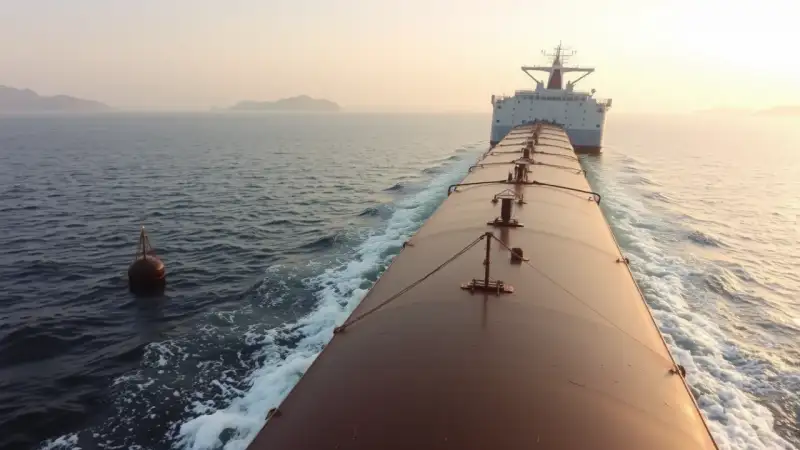
On November 21, 2026, tankers leaving the Persian Gulf through the Strait of Hormuz were hit by unidentified projectiles twice near the Omani port of Khasab. On the same day, Iran’s navy said a tanker caught fire after striking a naval mine. These were the latest attacks as Tehran tries to control traffic through the waterway.
What Happened Near Khasab on November 21
The first incident came from the United Kingdom Maritime Trade Operations agency (UKMTO). It said a tanker sailing outbound through the Strait of Hormuz was hit on its stern by an unidentified projectile about 11 nautical miles north of Oman’s Khasab.
About 50 minutes later, the agency issued a second warning. It said it had received a report 17 nautical miles east of Khasab, Oman, at 0550 UTC, involving a tanker struck in its engine room. It was not immediately clear whether the two reports involved the same vessel.
According to UKMTO, no casualties were reported in either incident, while the environmental impact remained unknown. The agency told ships in the area to move with caution and to report anything suspicious while authorities investigate.
These strikes came one day after a similar attack on a tanker near Khasab on Friday that caused a fire on board, on November 20.
Iran’s Account of a Mine Strike
Iran’s navy gave a separate account on November 21. It said an oil tanker caught fire after hitting a naval mine in a restricted area east of the Strait of Hormuz. That claim has not been independently verified. It is also unclear whether it refers to either of the incidents logged by the UK agency.
This was not the first such claim from Tehran. Earlier this week Iran said three tankers hit mines east of Hormuz. Iranian naval forces have also warned shipping operators against entering designated restricted zones.
Why the Strait of Hormuz Matters
Khasab sits on Oman’s Musandam Peninsula, at the entrance to the strait. Before the Iran war began, nearly one-fifth of the world’s crude oil supply passed through this waterway. Attacks there affect shipowners, crews and insurers, and they put pressure on oil-importing countries that depend on Gulf supplies.
Iran has set restrictions on ships that want to pass through the strait. It has attacked ships it says violated those restrictions, as it seeks to assert control over the strategic waterway and exert pressure on Washington.
The campaign has gone beyond shipping. During the week of November 19, 2026, Iran moved onto the offensive, attacking ships in the strait and launching airstrikes on several countries around the Persian Gulf.
Background: How the Strait Became a War Zone
The current conflict followed US and Israeli strikes on Iran, which killed Supreme Leader Ayatollah Ali Khamenei and prompted Iranian missile retaliation. After those strikes, Iran’s Islamic Revolutionary Guard Corps sent out radio warnings saying the strait was effectively closed to all ships.
Shipping traffic fell sharply after that. Ships waited outside the Gulf of Oman or turned around in the middle of a transit. Most major shipowners and operators have suspended operations through the Strait of Hormuz. Danish shipping company Maersk suspended all future transits through the strait until further notice.
FAQ
– Who is responsible for the November 21 attacks?
No one has been officially identified. UKMTO described the weapons only as unidentified projectiles. Iran’s navy blamed a mine for a tanker fire in a restricted area, but did not tie that claim to the incidents near Khasab.
– Was anyone hurt?
No casualties were reported in either incident UKMTO logged on November 21. The environmental impact had not been confirmed.
– What is UKMTO?
The United Kingdom Maritime Trade Operations is a British maritime security agency. It sends warnings to commercial ships about attacks and other threats in the region.