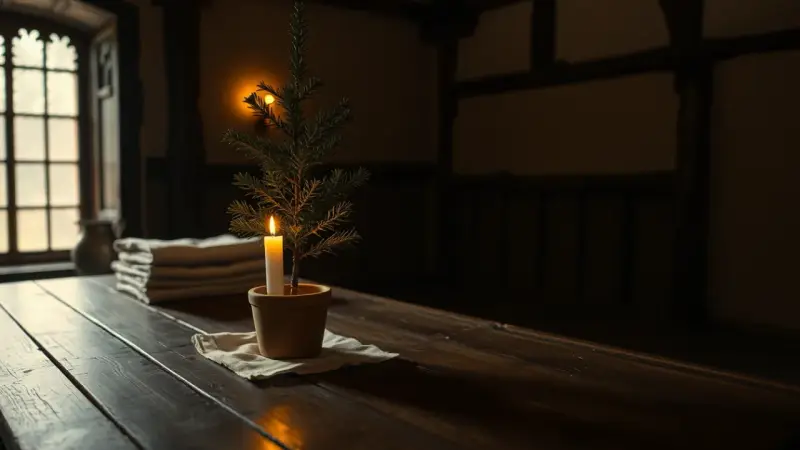
The Christmas tree tradition started in Germany and the Baltic region in the 1400s and 1500s. The earliest records describe decorated trees put up by merchant guilds in Tallinn (1441) and Riga (1510). Families in Germany were bringing trees into their homes by the 1600s. By the early 1900s, it was a standard part of Christmas in American homes.
Long before that, people used evergreens in winter as a sign that life goes on. The decorated indoor tree you know today, though, comes from a specific time and place, and the records that document it can be kept apart from the legends.
Where did the Christmas tree tradition originate?
The Christmas tree tradition began in Central Europe and the Baltic, mainly in German-speaking towns and in Livonia, the region that is now Estonia and Latvia. Two Baltic capitals both claim the first tree. Tallinn claims to have used a modern Christmas tree in its town square in 1441, while Riga claims to have done the same in 1510.
The two cities agree on one thing. Both accounts trace the tradition to midwinter ceremonies held by the Brotherhood of the Blackheads, a medieval guild of young, unmarried German merchants living in both Hanseatic cities on the Baltic Sea. Estonian historian Jüri Kuuskemaa backs Tallinn’s date. “I believe we can confidently use that date as the world’s first Christmas tree,” he said on ETV.
The Riga tree may not have been a living tree at all. Going by Riga’s guild records, the 1510 “tree” was likely a wooden frame shaped like a tree and hung with dried flowers, fruit, vegetables and straw toys. Tallinn bases its rival claim on the belief that its 1441 ceremony used a real spruce. Today a marker in Riga’s Town Hall Square shows where the tree is said to have stood.
Christmas tree history timeline
| Year | Event |
|---|---|
| c. 723 | Legend: St. Boniface cuts down an oak sacred to Thor in Germany, and a fir comes to stand for the new faith |
| 1400s | “Paradise trees” hung with apples appear in December 24 plays about Adam and Eve |
| 1441 | Tallinn, Estonia: tree in Town Hall Square, per city archives |
| 1510 | Riga, Latvia: Blackheads guild decorates a tree in the main square |
| 1521 | Sélestat, Alsace: town records mention Christmas trees |
| 1539 | Earliest recorded Christmas tree in a cathedral, at Strasbourg |
| 1604 | A Strasbourg chronicle describes trees in homes hung with paper roses, apples and sweets |
| 1747 | Moravian settlers in Bethlehem, Pennsylvania, leave the first American record of Christmas trees |
| 1848 | A published picture of Queen Victoria and Prince Albert’s tree at Windsor Castle sets off a fashion in Britain and America |
| 1882 | Edward H. Johnson, an associate of Thomas Edison, puts electric lights on a Christmas tree in New York |
| 1923 | President Calvin Coolidge lights the first National Christmas Tree in Washington, D.C. |
Paradise trees and the medieval roots of the Christmas tree
A paradise tree was an evergreen hung with apples. It served as the stage prop in medieval religious plays about Adam and Eve, which were performed on December 24. December 24 was Adam and Eve’s Day on the early Christian calendar, and the plays were a way to teach the Bible to people who mostly could not read. The apples stood for the fruit of Eden. Later on, round ornaments took their place on the branches.
Alsace has some of the earliest town records. In Sélestat, records from 1521 show how popular the trees had become, and authorities limited each household to one tree no taller than “eight shoe lengths,” just over a meter. A Strasbourg chronicle from the early 1600s describes trees in homes hung with roses of colored paper, apples, wafers, gold foil and sweets.
Legend vs. documented history
Several well-known origin stories are legends. Nothing in the record backs them up. Here is how they compare with what is documented:
- Martin Luther and the candlelit tree (legend). In the story, the Protestant reformer saw stars shining through the evergreens and brought home a tree lit with candles to recreate the sight. The story is popular, but it was attached to Luther long after his death.
- St. Boniface and Thor’s oak (legend). In this 8th-century tale, the missionary fells a sacred oak and points to a young fir as a Christian symbol. It is a teaching story, not a record of an early Christmas tree.
- Pagan evergreens (background, not a direct origin). Romans decorated with greenery during Saturnalia, and northern Europeans used evergreens in midwinter as symbols of life. These customs explain why evergreens carried meaning, but they are not the decorated Christmas tree.
- Baltic guild trees (documented). The Tallinn and Riga records from 1441 and 1510 are the earliest written evidence tied to a specific year and place.
- Market sales and church trees (documented). The Sélestat records and the 1539 Strasbourg cathedral tree show the custom becoming settled in German-speaking lands.
When did the Christmas tree tradition start in America?
The Christmas tree tradition in America started with German-speaking settlers in Pennsylvania in the 1700s. The first record comes from the Moravian Church settlement in Bethlehem, Pennsylvania, at Christmas 1747. More German immigrants arrived in the 1830s and 1840s and brought the custom with them.
At first, many Americans with English roots saw the tree as a foreign novelty. Some Puritan-influenced communities in New England had been wary of Christmas celebrations in general. That changed after 1848, when an image of Queen Victoria, her German-born husband Prince Albert and their children around a decorated tree at Windsor Castle was published. Fashionable households in Britain and the United States copied it.
Two inventions then turned the tree into a fixture. Electric lights, first shown on a tree by Edward H. Johnson in 1882, took the place of risky candles over the following decades. In 1923, the first National Christmas Tree lit by President Coolidge in Washington made the tree a public American symbol. By the early 1900s, a decorated tree was a standard part of Christmas in homes across the country.
A side note on Canada: German troops stationed in Quebec during the British colonial era have been credited with the first tree in North America, but that claim is disputed.
What does the Christmas tree symbolize?
The Christmas tree symbolizes life that lasts through winter, because evergreens stay green when other trees are bare. In Christian tradition, the apple-hung paradise tree pointed to the Garden of Eden, and the lights came to stand for Christ as the light of the world. Today, many families also see the tree as a cultural and family tradition, apart from religion.
FAQ
– When should you officially put up your Christmas tree?
No official date exists for putting up a Christmas tree. In the US, many families decorate the weekend after Thanksgiving, which falls on Thursday, November 26, in 2026. Another custom is to start with Advent, which begins Sunday, November 29, 2026. Under older European tradition, the tree went up on Christmas Eve and stayed until Epiphany on January 6.
– Was December 25 a pagan holiday?
December 25 was not a major pagan festival in the way it is often claimed, though Rome’s Saturnalia was celebrated in mid-December. Historians still debate whether the early church picked December 25 to line up with Roman winter festivals or worked out the date in other ways. Either way, the Christmas tree itself appeared more than a thousand years later.
– What do psychologists say about putting up your Christmas tree early?
There’s no expert rule that sets a right date. Decorating early is a personal choice: if familiar decorations make the season feel longer and cozier, starting early does no harm. If the holidays bring up stress or grief for you, go with the timing that feels right.
– When were candles on Christmas trees replaced?
Electric lights began replacing candles on Christmas trees after Edward H. Johnson’s lit tree in New York in 1882. Electric strings were expensive at first, so candles stayed in use for years. Electric lights became the norm in the early 20th century, partly because candles were a fire risk.